
Model settings
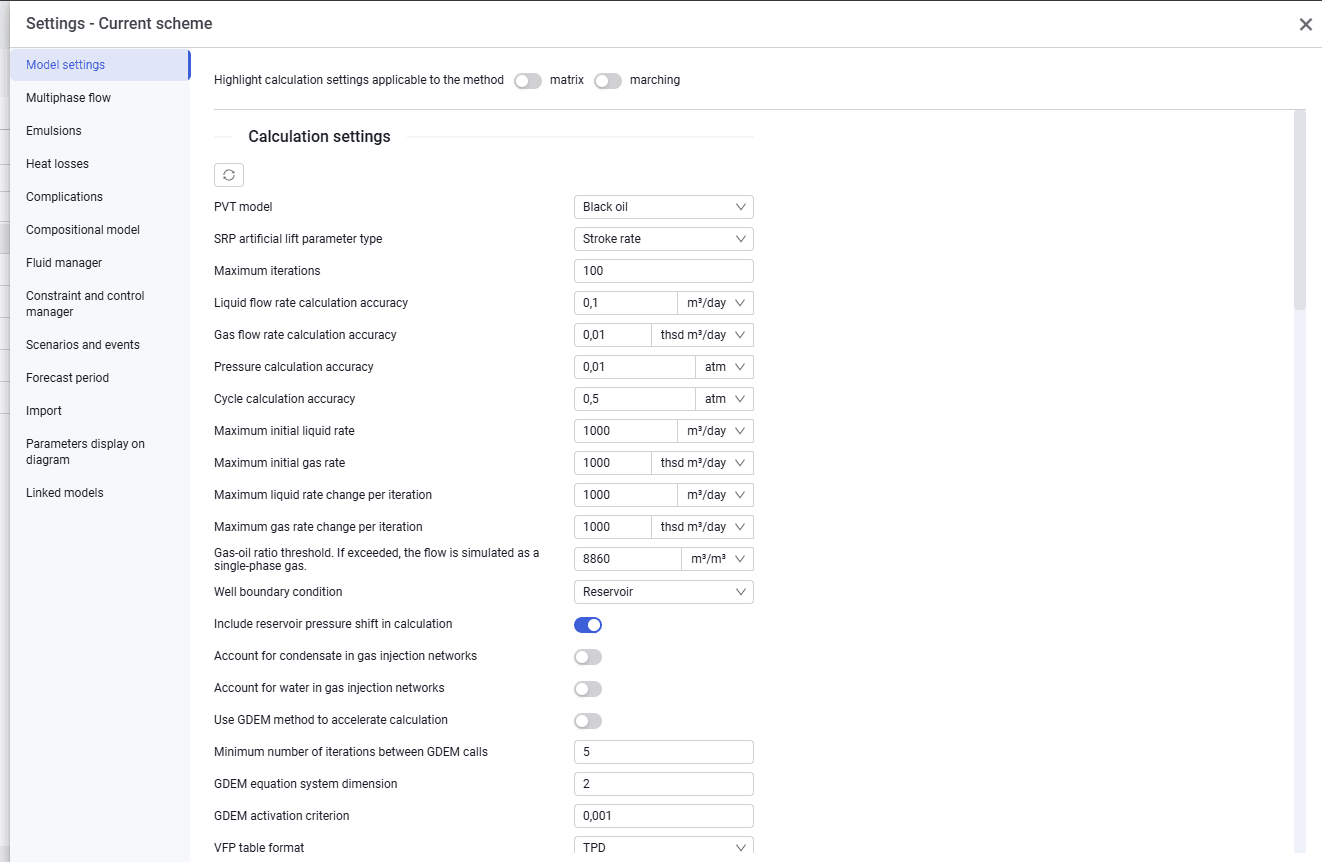
The "Model settings" tab looks as follows.
 Select image to enlarge
This window displays calculation and optimization settings. You can adjust them if required. Available calculation settings:
- PVT model type (Tracking or Black oil);
- SRP artificial lift parameter type. The drop-down list includes stroke length and stroke rate;
- maximum iterations. A control parameter of the numerical solver
that determines how many steps the algorithm will try to find a solution that meets the specified accuracy criteria; - liquid flow rate calculation accuracy, gas flow rate calculation accuracy, pressure calculation accuracy, cycle calculation accuracy. The smaller the values, the more accurately the model will converge and the more iterations may be required to find a solution;
- maximum initial liquid rate, gas rate. Defines the upper bound for the initial rate guess at the first calculation iteration;
- maximum liquid rate change per iteration, gas rate. Limits how much a variable can be changed in one step;
- GOR threshold. If it is exceeded, flow is modeled as a single-phase gas stream;
- well boundary condition. The drop-down list includes reservoir and wellhead;
- include reservoir pressure shift in calculation;
- use GDEM method to accelerate calculation. An iterative convergence acceleration algorithm
for solving systems of equations, based on extrapolation of successive approximations; - minimum number of iterations between GDEM calls. Defines the minimum number of iterations of the base method that must be performed between successive applications of GDEM acceleration;
- GDEM equation system dimension;
- GDEM activation criterion;
- VFP table format. The drop-down list includes E100 and TPD;
- joint calculation of production and gas lift networks;
- decline curve model type. The drop-down list includes external or internal;
- Calculate inhibitor concentrations;
- Fluid properties for choke calculations in Tracking mode (Black Oil or compositional).
- Temperature calculation accuracy;
- Maximum temperature change per iteration;
- Maximum length of pipe section;
- Relaxation coefficient;
- Number of parallel processing cores.
Common optimizer settings:
- take into account well and inflow constraints. The drop-down list includes all constraints and only for wells and inflows with control;
- maximum choke pressure drop.
Rule Based Solver settings:
- objective function. The drop-down list includes maximum oil flow rate, maximum liquid flow rate, minimum liquid flow rate, maximum gas flow rate, minimum gas flow rate, production, maximum or minimum water or gas injection rate;
- maximum iterations. Limits the number of optimization steps;
- liquid flow rate constraint accuracy, gas flow rate constraint accuracy, pressure constraint accuracy. Allowed deviation from the specified constraints;
- minimum control parameter change for stopping calculation. Stopping criterion when an optimization "plateau" is reached;
- maximum ESP frequency change, pressure change, gas lift rate change. Prevents abrupt changes;
- penalty parameter for high water cut wells;
- oil/condensate weighting factor;
- Calculate constraints for the maximum choke pressure drop to prevent wells from being shut in;
- Take into account priority for control parameters (parameters with and without energy consumption).
Constrained optimizer settings:
- objective function. The drop-down list includes maximum oil flow rate, maximum liquid flow rate, minimum liquid flow rate, maximum gas flow rate, minimum gas flow rate, production, maximum or minimum water or gas injection rate;
- maximum iterations. Limits the number of optimization steps;
- minimum control parameter change for stopping calculation. Convergence criterion. If changes in control parameters (for example, frequency) at the next step become smaller than this value, the process is considered converged;
- maximum ESP frequency change, pressure change, gas lift rate change, SRP stroke rate change. Prevents abrupt changes;
- number of approximation points for objective function and constraints. The more points, the more accurate the model, but the longer the calculation;
- stop optimization when there is no improvement in the objective function and constraints. This mechanism prevents "running in place", when further iterations do not provide a meaningful improvement;
- relative threshold for checking the absence of improvement in the objective function and constraints. By how many % (as a unit fraction) the objective function value must improve for the step to be considered successful. If the improvement is less than this threshold — the step is "unsuccessful";
- number of times the no-improvement criterion for the objective function and constraints is triggered, after which optimization is stopped;
- constraint approximation method. Linear and quadratic methods are available.
Inhibitor injection optimizer settings:
- Minimum allowed pressure difference between the hydrate formation curve and the pressure in the pipeline;
- Minimum allowed temperature difference between the hydrate formation curve and the temperature in the pipeline.
- Default maximum reagent flow.
- Initial radius of the trust region of the SQP algorithm;
- Final radius of the trust region of the SQP algorithm — corresponds to the accuracy of inhibitor rate selection.
Above each settings section there is a button  that resets values to defaults.